
Travel Hacks CWBiancaVoyage: What the Site Covers, Its Best Tips, and How to Use Them
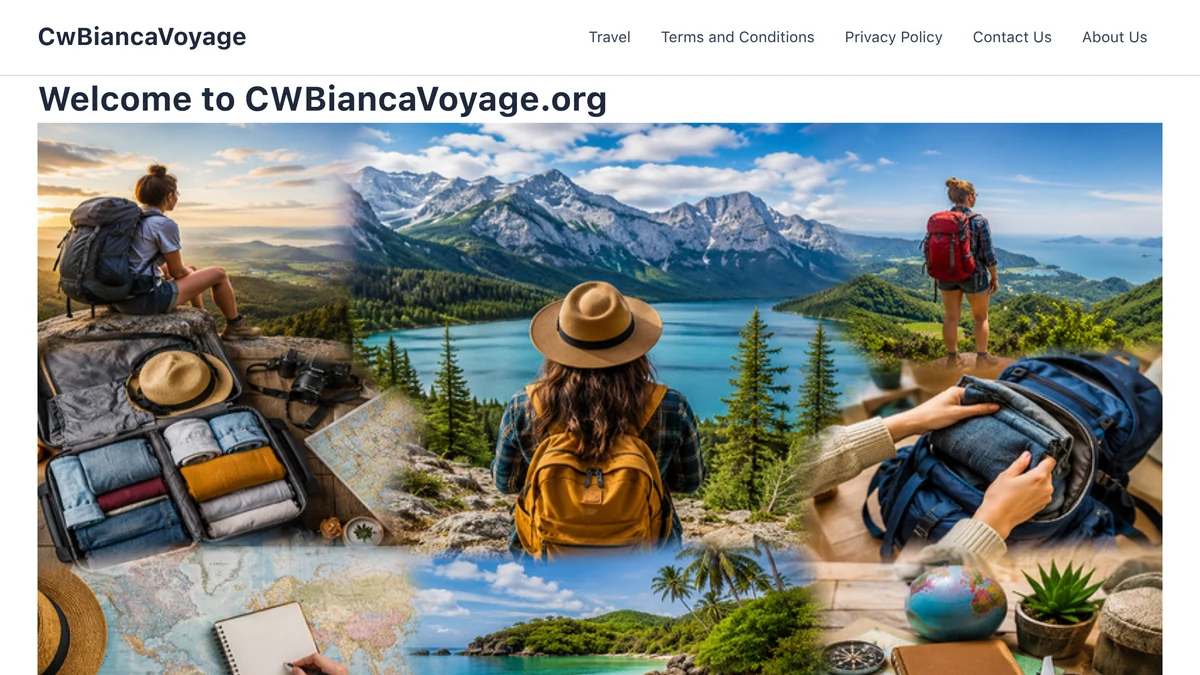

Travel Hacks CWBiancaVoyage is the core topic of cwbiancavoyage.org, a travel guide and blog that promises practical advice for trips that are easier, cheaper, and less stressful. The site covers travel hacks in two places: two homepage sections that list the main ideas, and three full articles by the same author, Asher Sameul, published on November 1, November 17, and November 24, 2025. The articles walk through planning, packing, airports, money, safety, and digital tools, and they name specific rules such as the Half Rule for packing and the 5-4-3-2-1 rule for a week of clothes. The site itself is information only. It has no shop, no prices, no booking, and no payment feature, and its About page names no founder and no team. This article explains what the site is, what its travel hacks actually say, how to use them, and what the site does not tell you.
At a Glance
| Question | Short answer |
|---|---|
| What is CWBiancaVoyage? | A travel guide and blog at cwbiancavoyage.org, built on WordPress with the Astra theme. |
| What is its main topic? | Travel hacks, plus backpacking advice, easy traveling, and packing guides. |
| How many full Travel Hacks articles are there? | Three, all by Asher Sameul, dated November 1, 17, and 24, 2025. |
| Who runs the site? | No founder or team name is shown on the About page. |
| How do you contact the site? | By email at dailyhappystyle@gmail.com. The Contact page has no form. |
| Can you book or buy anything on the site? | No. There is no shop, cart, price, booking, or payment feature. |
| Does the homepage show a date? | No date is shown on the homepage. |
What CWBiancaVoyage Is
CWBiancaVoyage is a travel guide and blog at cwbiancavoyage.org. The homepage heading reads “Welcome to CWBiancaVoyage.org Home”, and the site describes its mission as providing practical travel guides, honest advice, destination inspiration, and easy to follow resources for travellers of every experience level. The footer reads “Copyright (c) 2026 CwBiancaVoyage | Powered by Astra WordPress Theme”, which shows the site runs on WordPress with the Astra theme. The header navigation is short and the same on every page: Travel, Terms and Conditions, Privacy Policy, Contact Us, and About Us. There is no search box, no cart, and no account link in the header.
Three things the site is not matter as much as what it is. First, it is not a booking site. On the homepage, the Travel archive, all three Travel Hacks articles, the About page, and the Contact page, there is no shop, no price, no book button, and no checkout, so nothing on the site can be bought or reserved. Second, it is not a tour operator. It publishes guides and tips, and it does not list tours, departures, or packages. Third, it is not the only place using this name. A web search also returns other domains using the same name, so a reader should check that the address bar shows cwbiancavoyage.org before trusting that the page in front of them is this site.
One small behaviour is worth knowing before you visit. The site first shows a short automatic “Checking your browser” page, which clears on its own after a few seconds with no puzzle to solve, and the homepage then loads normally. That check is part of the site, not a sign that the site is down.
Who Is Behind the Site
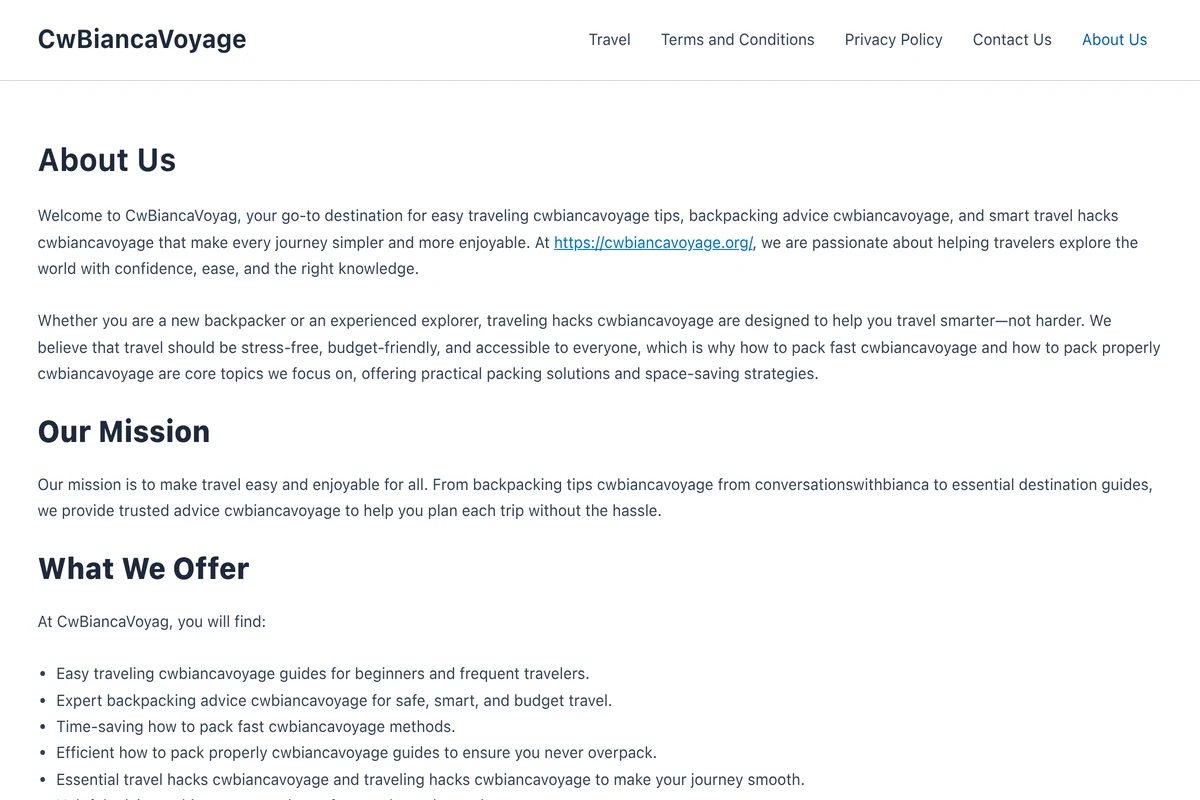
The About page is headed “About Us”, and it describes the site as a go-to destination for easy traveling, backpacking advice, and travel hacks, aiming to make travel stress-free, budget-friendly, and accessible to everyone. Its sections are “Our Mission”, “What We Offer”, “Why CwBiancaVoyag?”, and “Join Our Journey”. The mission is simple: to make travel easy and enjoyable for all. The “What We Offer” list covers easy traveling guides, backpacking advice, how to pack fast and how to pack properly, travel and traveling hacks, advice from real travel experiences, and backpacking tips from conversationswithbianca. The page calls the site “not just a travel blog” and describes it as a travel companion instead.
Two facts about the About page deserve a plain statement. First, no founder or team name appears anywhere on the page. The site does not say who writes it, who edits it, or who owns it, and the three Travel Hacks articles are the only place a name appears, in the byline “By Asher Sameul”. Second, no email, phone number, or address is shown on the About page itself. The only contact detail on the whole site is an email address on the Contact page, which is covered later in this article.
A small spelling detail is also worth noting because it appears in the site’s own text. The About page spells the name “CwBiancaVoyag” in its body text, without the final “e”, while the logo and the domain spell it “CwBiancaVoyage”. That is how the page itself is written, and it is a useful reminder to copy the domain exactly when you type the address.
What the Site Covers
The homepage is a long page of sections, and travel hacks sit in the middle of a wider set of topics. The sections, in the order they appear, are “Discover the Best Backpacking Tips CWBiancaVoyage from ConversationsWithBianca”, “Practical Backpacking Advice CWBiancaVoyage for Every Traveller”, “Easy Traveling CWBiancaVoyage, Making Every Journey Simpler”, “Travel Hacks CWBiancaVoyage That Save Time and Money”, “Traveling Hacks CWBiancaVoyage for Modern Explorers”, “Trusted Advice CWBiancaVoyage for Every Destination”, “How to Pack Fast CWBiancaVoyage Without Forgetting Essentials”, “Traveling Tips CWBiancaVoyage for Comfortable Adventures”, “NLDBurma CWBiancaVoyage Backpacking Advice”, “How to Pack Properly CWBiancaVoyage for Every Trip”, “Explore Inspiring Destinations Around the World”, “Smart Budget Travel Strategies”, “Responsible and Sustainable Travel”, “Why Readers Choose CWBiancaVoyage.org”, and “Start Your Next Adventure with CWBiancaVoyage.org”.
The backpacking sections cover budgets, insurance, documents, budget accommodation, health, common mistakes, and transportation. The easy traveling section covers itineraries, transportation, packing only what is needed, airport procedures, staying organised, and adapting to surprises. The packing sections cover fast packing and proper packing, which the About page calls core topics, with practical packing solutions and space saving strategies. The budget section covers smart budget travel strategies, and the responsible travel section covers sustainable habits and responsible tourism.
The two homepage Travel Hacks sections are summaries, not full articles, and they are the best place to see the whole topic at a glance. The first, “Travel Hacks CWBiancaVoyage That Save Time and Money”, lists seven ideas: finding affordable flights, booking accommodation wisely, organising travel documents digitally, maximising luggage space, reducing unnecessary expenses, staying connected while travelling internationally, and protecting valuables during your trip. The second, “Traveling Hacks CWBiancaVoyage for Modern Explorers”, lists eight topics: mobile travel apps, digital boarding passes, currency management, public transportation tips, solo travel safety, sustainable travel habits, remote work while travelling, and responsible tourism. A family travel guide helps with exactly the kind of planning these sections describe, because a family trip needs one base, one main activity a day, and room for breaks, and that is the same slow and simple structure the site recommends for every trip.
The Travel Hacks Content: Three Full Articles
The full articles live in the Travel archive at cwbiancavoyage.org/category/travel/, which runs to two pages, and the three hacks articles sit together there. All three are by Asher Sameul, and each one is a complete guide rather than a list of headlines. Their dates are November 1, November 17, and November 24, 2025, and those dates are shown on the article pages themselves. The homepage shows no date, so the article dates are the only dates the site gives for its travel hacks content.
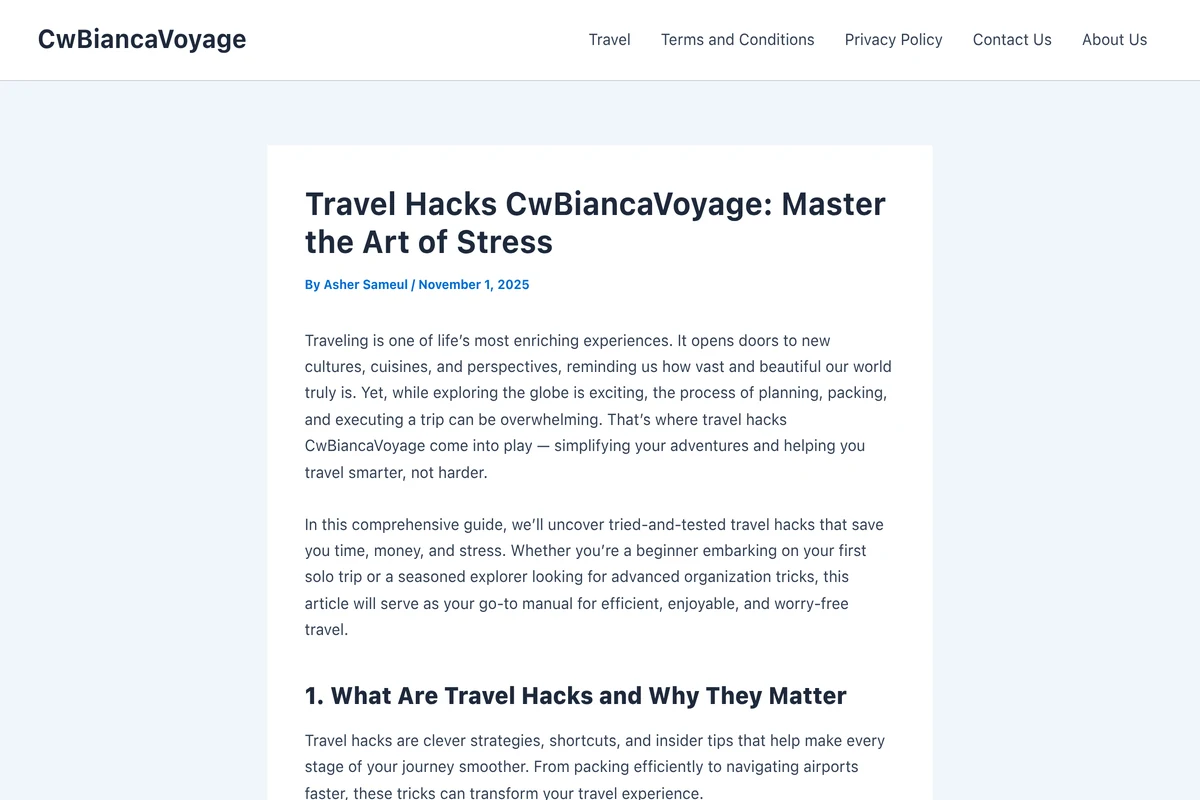
The first article is titled “Travel Hacks CwBiancaVoyage: Master the Art of Stress”. The title ends at “Stress”, not “Stress-Free”, which is how the page itself shows it. It has 15 numbered sections plus Final Thoughts, and it starts by defining travel hacks as clever strategies, shortcuts, and insider tips that make every stage of a journey smoother. Its pre-trip planning section uses a master checklist for documents, electronics, clothing, toiletries, and miscellaneous items, and it advises researching local culture and laws, plus booking smart with fare alerts and hidden-city or open-jaw tickets. Its packing section says to roll, not fold, to use compression bags and multi-use items, and to follow the Half Rule: lay out everything, then remove half. Its airport section recommends online check-in 24 hours ahead, TSA PreCheck or Global Entry, keeping essentials accessible, and carrying a reusable water bottle. Its accommodation section recommends booking directly, checking neighbourhood reviews, using loyalty programs, and packing a door stopper. Later sections cover transportation with offline maps, a local SIM or eSIM, public transit passes, and walking; money with no-foreign-transaction-fee cards, ATM cash, eating like a local, and off-peak seasons; safety with copies of documents, blending in, scam awareness, and travel insurance; health with hydration, rest and jet lag, fresh food, and light exercise; digital tools with TripIt, Google Translate, XE Currency Converter, and PackPoint; sustainable travel; handling emergencies; making the most of every destination; the mindset of a smart traveler; and returning home smoothly by unpacking, doing a post-trip review, backing up photos, and planning the next trip.
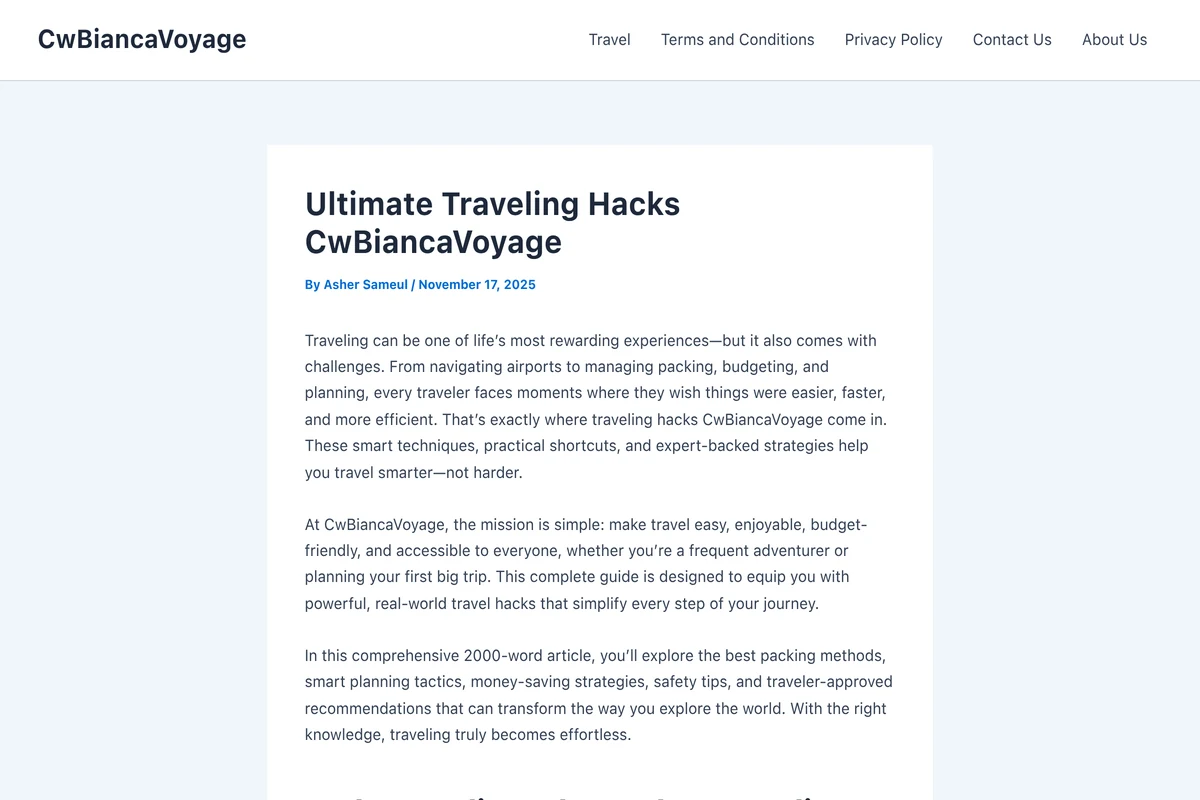
The second article is titled “Ultimate Traveling Hacks CwBiancaVoyage”, dated November 17, 2025. It describes itself on the page as a comprehensive 2000-word article, and it opens with five themes: smart planning, efficient packing, budget awareness, safety preparedness, and realistic flexibility. Its planning section names digital tools such as Google Trips, TripIt, and Wanderlog, and it advises booking flights smart with incognito mode, flexible dates, regional airports, and mid-week booking through Skyscanner or Momondo. Its packing section repeats the roll, not fold, advice, adds packing cubes and multi-purpose items, and sets out the 5-4-3-2-1 Rule: 5 tops, 4 bottoms, 3 accessories, 2 shoes, and 1 jacket. It also advises leaving “just-in-case” items behind and keeping a pre-packed toiletry kit. Its airport and flight section covers early online check-in, a security strategy, a reusable bottle, overnight flights, and your own entertainment. Its accommodation section puts location over luxury, compares Airbnb, Booking.com, Agoda, Hostelworld, and Expedia, warns about hidden fees, and advises staying near city centres. Its transportation section covers public transport, offline maps, walking, and ride-sharing with Uber, Bolt, and Grab. Its budget section covers shoulder seasons, cooking occasionally, cashback and reward cards, avoiding tourist traps, and travel insurance. Its safety section covers sharing your itinerary, hiding valuables, avoiding displays of wealth, staying aware, and not trusting everyone too quickly. Its final section covers cultural and social hacks: respect customs, dress appropriately, try local food, and learn greetings and thank you in the local language.
The third article is titled “By ConversationsWithBianca Traveling Hacks CwBiancaVoyage”, dated November 24, 2025. Its title is the oddest of the three, because it begins with “By ConversationsWithBianca”, which is the name of a related blog rather than a person, while the byline on the page still reads “By Asher Sameul”. It opens by saying the hacks reduce planning time, help you pack light and smart, minimise stress, improve safety, and save money on flights, hotels, and food. Its planning section sets out a Rule of 3, three things to experience, three to avoid, and three to prepare for, and it advises researching through local blogs, government sites, Facebook groups, Google Travel, and TikTok or Instagram. It advises Tuesday to Wednesday flights and booking 6 to 8 weeks ahead for international trips, plus keeping a digital folder of passport, IDs, bookings, and emergency contacts. Its packing section gives a 5-4-3-2-1 formula for one week: 5 shirts, 4 pairs of pants or shorts, 3 pairs of shoes, 2 jackets or sweaters, and 1 dressy outfit, with rolling, packing cubes, essentials first, and a personal comfort kit of pain reliever, lip balm, snacks, wet wipes, earplugs, an eye mask, and tissues. Its money section advises avoiding tourist restaurants, choosing smart accommodation including hostels, guesthouses, and work exchange, using ATMs over currency exchanges, travelling in off-peak seasons, and using free activities. Its safety section advises sharing your live location, scanning the hotel room on arrival, carrying a fake wallet, using crossbody bags, and staying alert. Its transportation section advises offline maps, local transport apps, emergency cash, and arriving 3 hours early for international trips or 30 minutes early for bus and train trips. Its hotel section advises a higher floor, a corner room, using the room TV as a charger, and checking the bed. Its eating section advises your own water bottle, local fruit markets, and food safety. Its tech section advises a universal adapter, translator, currency, offline-maps, and booking apps, plus a charged power bank. Its final section advises buffer time, packing intentionally, keeping essentials accessible, carrying fewer items, and staying flexible.
The Hacks, Grouped by Trip Stage
Read together, the three articles repeat the same ideas in different words, and grouping them by trip stage makes them easier to use. The grouping below is my own summary of what the site says, not a fourth article on the site, and each group draws on all three articles.
Planning and booking come first. Make a master checklist before you book anything, and keep a digital folder with your passport, IDs, bookings, and emergency contacts. Research the destination through local blogs, government sites, and traveller groups, not only through one search result. For flights, use fare alerts, compare flexible dates, consider regional airports, book mid-week, and book international trips 6 to 8 weeks ahead. The site also mentions hidden-city and open-jaw tickets as a booking idea. Treat that one with care, because it can break airline rules and leave you without a return flight, so read the fare conditions before you try it.
Packing is the second group, and it is the most detailed part of the site. Roll clothes instead of folding them, use packing cubes and compression bags, and choose multi-use items. The Half Rule is the simplest test: lay out everything you plan to take, then remove half. The 5-4-3-2-1 rule is the most specific test: for one week, take 5 tops, 4 bottoms, 3 accessories, 2 shoes, and 1 jacket, or in the third article’s version, 5 shirts, 4 pairs of pants or shorts, 3 pairs of shoes, 2 jackets or sweaters, and 1 dressy outfit. Leave “just-in-case” items at home, keep a pre-packed toiletry kit, and carry a small comfort kit with pain reliever, lip balm, snacks, wet wipes, earplugs, an eye mask, and tissues. Pack essentials where you can reach them, and keep documents, medication, and a change of clothes in your hand luggage.
Airport hacks are the third group. Check in online as early as the airline allows, and keep your documents and liquids where you can reach them at security. TSA PreCheck gives trusted travellers a faster security experience in dedicated lanes in the United States, and the official TSA page says about 99 percent of passengers wait less than 10 minutes, with five years of benefits for 85 dollars or less. Take a reusable water bottle and fill it after security, and carry your own entertainment for long waits and overnight flights. For transport after landing, use offline maps, a local SIM or eSIM, public transit passes, and ride-sharing apps such as Uber, Bolt, and Grab, and walk when the distance is short. On a road trip, plan it like a scenic drive: allow extra time, choose a few stops, and do not treat the road as a shortcut.
Money is the fourth group. Use a card with no foreign transaction fee, take cash from ATMs rather than currency exchanges, and eat where local people eat instead of at tourist restaurants. Travel in shoulder seasons, cook occasionally when your stay allows it, use cashback and reward cards, and watch for hidden fees on accommodation bookings. Compare stays across Airbnb, Booking.com, Agoda, Hostelworld, and Expedia, and put location over luxury, because a central stay can save more in transport than a cheaper room on the edge of town saves in rent. XE Currency Converter shows live exchange rates for more than 100 currencies, with rate alerts and an app, which is useful when you are deciding whether to exchange cash now or later.
Safety and health are the fifth group. Keep copies of your documents separate from the originals, share your itinerary or live location with someone at home, and stay aware of your surroundings. Blend in where you can, avoid displaying wealth, and do not trust everyone too quickly. In the hotel, scan the room on arrival, use a crossbody bag outside, and keep a small amount of emergency cash apart from your main wallet. For health, drink water, rest properly, manage jet lag with sleep rather than caffeine alone, eat fresh food, and move a little each day. Travel insurance appears in all three articles, and it is the one item the site treats as essential rather than optional.
Digital tools are the sixth group. The site names TripIt, Google Translate, XE Currency Converter, PackPoint, Google Trips, and Wanderlog for planning, packing, translation, currency, and itineraries. Download offline maps and a translator before you travel, keep a charged power bank, and carry a universal adapter. Keep your bookings, tickets, and boarding passes on your phone, but keep a paper or offline copy of the most important ones, because a dead battery or a lost signal can leave you with nothing to show at a gate.
How to Use the Site
Start on the homepage and read the two Travel Hacks sections first, because they give the whole topic in a few lines. Then open the Travel archive and read the three full articles in date order: “Travel Hacks CwBiancaVoyage: Master the Art of Stress” from November 1, 2025, then “Ultimate Traveling Hacks CwBiancaVoyage” from November 17, 2025, then “By ConversationsWithBianca Traveling Hacks CwBiancaVoyage” from November 24, 2025. Reading them in order shows how the same rules return in each article with different details, and it makes the repetition easier to spot. The first article is the most complete, the second is the most practical for booking and packing, and the third is the most detailed for money, safety, and hotel habits.
Use the rest of the site the same way. The backpacking sections help with budgets, insurance, documents, and transport, and the packing sections help when the hacks articles tell you to pack light but do not show you how. The easy traveling section helps with itineraries and airport procedures, and the destinations section gives ideas for where to use the hacks. The site is a reading site, not a tool, so take notes as you read and build your own checklist from the rules that fit your trip, rather than trying to follow all three articles at once.
Before you travel, check the official Travel Advisories for your destination, because the site’s safety advice is general and does not cover any one country. Advisories use categories such as crime, terrorism, unrest, health, natural disaster, and kidnapping, and they change over time, so a tip written in November 2025 may not match the situation on your travel dates. Check current ferry, flight, and accommodation conditions the same way, and confirm any price or rule on the official site before you rely on it.
If you want to ask the site a question, the Contact page is the only route, and it is email only. The address shown is dailyhappystyle@gmail.com, and the page says it welcomes questions on easy traveling tips, backpacking advice, how to pack fast or properly, travel and traveling hacks, guidance from conversationswithbianca traveling hacks, and feedback, suggestions, and collaboration, and that it aims to respond to emails as quickly as possible. There is no contact form on the page, no phone number, no postal address, and no contact-person name, so email is the whole contact method.
What the Site Does Not Tell You
The site leaves several gaps, and they are worth stating plainly. First, it never says who runs it. The About page names no founder and no team, and the only name on the site is the byline “By Asher Sameul” on the three articles. A reader cannot check the author’s background, and there is no editor, no reviewer, and no publication team listed anywhere. Second, the site gives no way to reach it except one email address, and it gives no phone number, no postal address, and no response time promise beyond aiming to respond as quickly as possible.
Third, the homepage shows no date, so a reader cannot tell from the homepage when the site was last updated. The only dates on the site are the three article dates in November 2025, and there is no sign of newer content after November 24, 2025. Fourth, the site has no prices, no booking, and no shop, so every money tip is general advice. It does not show what a flight, a hotel, or an eSIM actually costs, and it does not link to a booking page, so a reader must price everything elsewhere. Trip costs matter too: flights, transfers, stays, food, and local travel all sit on top of any saving a hack promises, and a complete trip total is the only honest way to judge whether a tip really saves money.
Fifth, some of the site’s own claims need care. The second article describes itself as a comprehensive 2000-word article, but that is the article’s own description of itself, not an independent measurement, and the site does not show a word count. The first article’s title ends at “Stress”, which reads like a cut-off title, and the third article’s title begins with “By ConversationsWithBianca”, which is a blog name rather than an author, while the byline still names Asher Sameul. The About page spells the site name “CwBiancaVoyag” without the final “e” in its body text. None of these details change the tips, but they show the site is not carefully edited, and a careful reader should check any fact that matters before acting on it.
Sixth, the tips themselves are general, not destination-specific. They work for most trips, but they do not cover visa rules, local laws, weather, or transport for any one place, and the hidden-city ticket idea can cause real problems with an airline. Finally, the site’s browser check page means a screenshot service may capture the check page instead of the real page, which is what happened when this article’s screenshots were first attempted. That is a technical detail, not a problem with the content, but it is a fair warning that the site can be awkward to capture or to archive.
Frequently Asked Questions
Is CWBiancaVoyage a booking site?
No. CWBiancaVoyage is a travel guide and blog only. It has no shop, no prices, no booking, and no payment feature on any page checked, so you cannot book or buy anything on the site itself.
Who wrote the Travel Hacks articles on CWBiancaVoyage?
All three full Travel Hacks articles carry the byline “By Asher Sameul”. The About page names no founder, editor, or team, so Asher Sameul is the only name the site gives for its travel hacks content.
What are the best travel hacks on CWBiancaVoyage?
The most repeated hacks are the Half Rule for packing, the 5-4-3-2-1 rule for a week of clothes, online check-in, TSA PreCheck, offline maps, a local SIM or eSIM, no-foreign-transaction-fee cards, ATM cash, eating like a local, and travelling in off-peak seasons. The site repeats these across all three articles, which is a sign it treats them as the core of the topic.
When were the Travel Hacks articles published?
The three articles are dated November 1, November 17, and November 24, 2025. The homepage itself shows no date, so those article dates are the only dates the site gives for its travel hacks content.
How do I contact CWBiancaVoyage?
By email only, at dailyhappystyle@gmail.com. The Contact page has no form, no phone number, and no postal address, and the About page shows no contact details at all.
Is CWBiancaVoyage free to use?
Yes. The site is free to read, with no membership, no paywall, and no payment feature on any page checked. Its only contact route is a free email address, and its guides and articles are open to read without signing in.
Final answer
CWBiancaVoyage is a small WordPress travel blog whose best content is three Travel Hacks articles by Asher Sameul from November 2025, supported by two homepage sections that summarise the same ideas. Its most useful advice is simple and repeatable: plan with a checklist, pack with the Half Rule or the 5-4-3-2-1 rule, check in early, use trusted traveller programs, keep maps and documents offline, pay with the right card, and stay aware. Its limits are just as clear: no founder or team is named, the only contact is one email address, the homepage shows no date, there are no prices or bookings, and the tips are general rather than destination-specific. Use the site as a starting checklist for a smoother trip, check current advisories and prices before you travel, and treat its rules as a framework to adapt, not as a fixed plan.

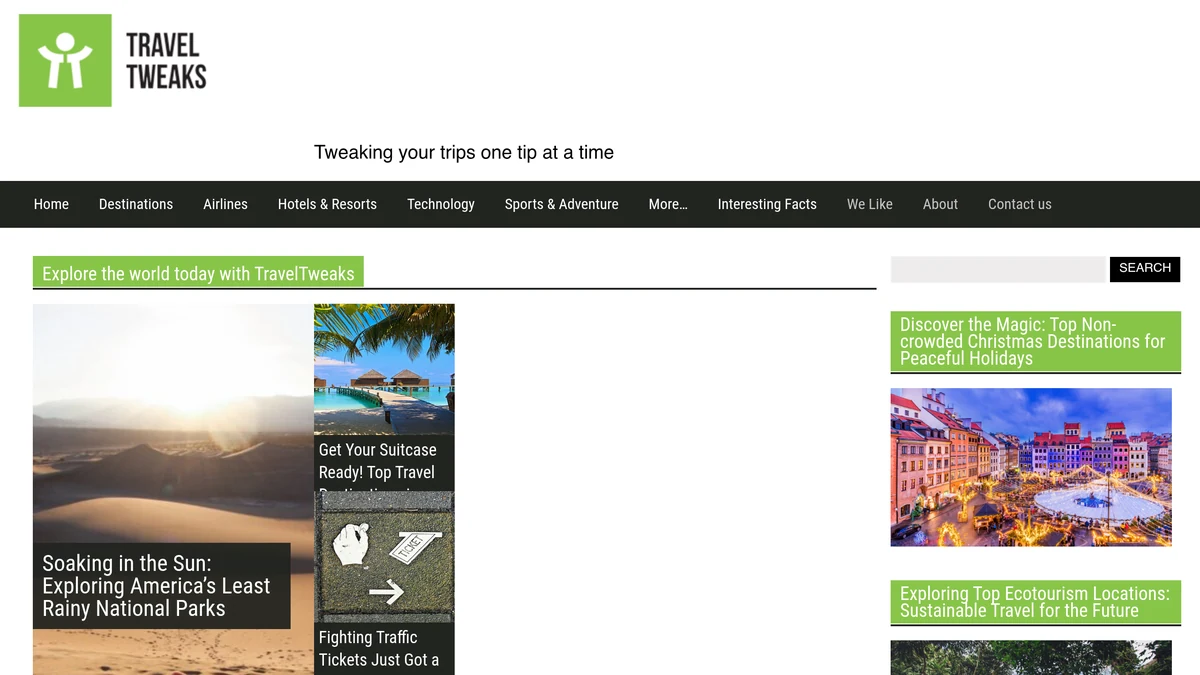
Travel Tweaks Hotels: How TravelTweaks.com Helps You Find Better Deals, Upgrades, and Smarter Hotel Stays
Travel Tweaks Hotels on traveltweaks.com: what the hotel search tool does, how to compare rates and get upgrades, the 10 hotel hacks grouped as the site shows them, and what the site does not do.
Intentmedia.com: What It Is, What It Covers, and How to Use It
Learn what Intentmedia.com covers, how its travel guides are organised, and how to use its destination and planning advice wisely.
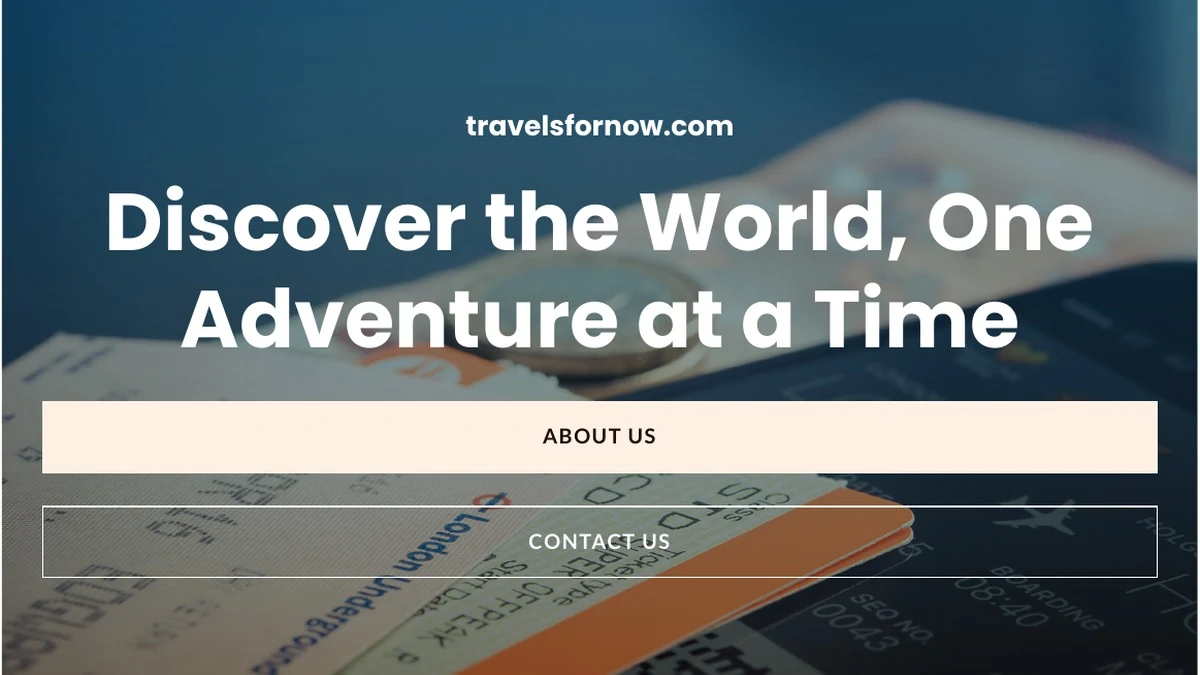
Travelsfornow.com: What It Is, What It Covers, and How to Use It
Learn what Travelsfornow.com covers, who runs it, and how to use its budget travel guides when planning a cheaper trip.