
Hoptraveler.com: A Complete Guide to the Travel Blog, Its Categories, and How to Use It

Hoptraveler.com is a travel news and guide website that publishes destination guides, travel tips, and travel news for readers around the world. It is not a travel agency, and it is not a booking service. It does not sell trips, and it does not take bookings on its own pages. It gives readers ideas, plans, and practical advice, and then sends them elsewhere to book. This guide explains what the site is, who runs it, what it covers, which recent articles are worth reading, and how to use it well for your own trip planning.
At a Glance
| Item | What we found |
| --- | --- |
| Website | Hoptraveler.com |
| Type | Travel news and guide blog built on WordPress |
| What it does | Publishes destination guides, travel tips, travel news, and category archives |
| Owner | HopTraveler Media |
| Team named on the About page | Elena Makree, John Garavelas, Nikolas Hine |
| Categories | 14 |
| Guides published | 15,000 or more, according to the About page |
| Homepage pages | Page 1 of 2,649 on the day we checked |
| Booking service | No |
| Contact | Email only at smooth954@yahoo.com, no form on the Contact page |
What Hoptraveler.com Is
Hoptraveler.com describes itself in one sentence that appears on the homepage and in the footer of every page. It calls itself your ultimate guide to travel, tourism, and adventure, with breaking travel news, expert tips, and trending destinations worldwide. That sentence is the best short answer to what the site is. It is a content site first, and everything on it is built around reading and planning, not buying.
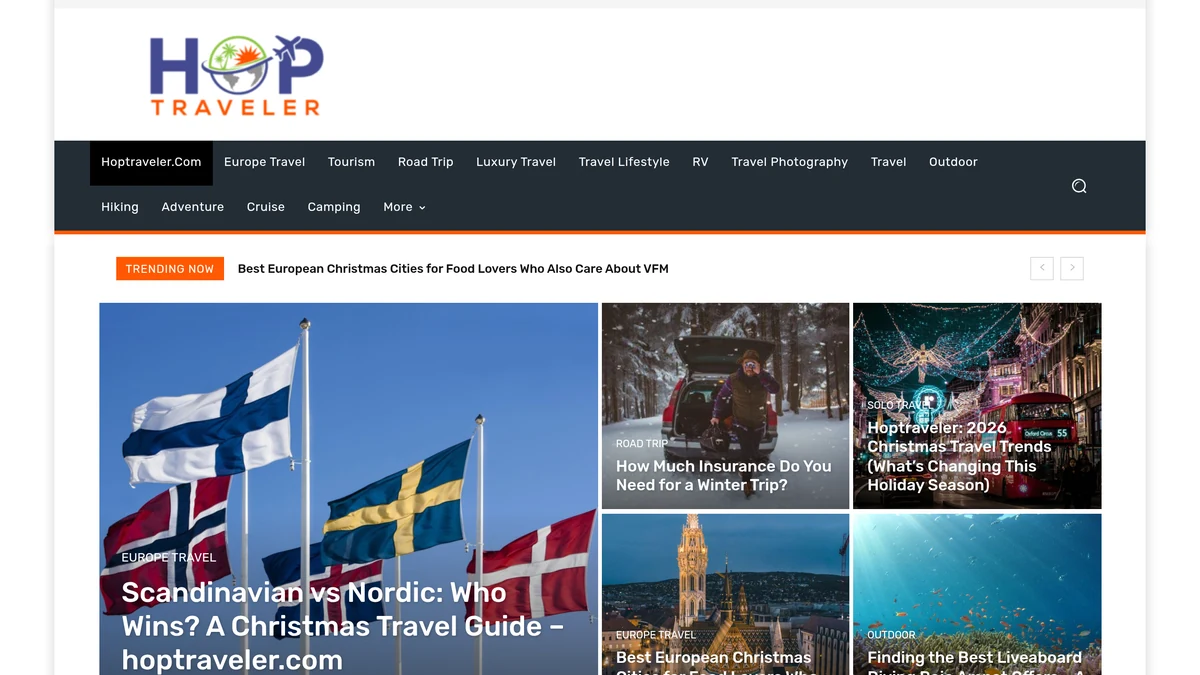
The homepage title in the browser reads “Travel with hoptraveler, home of hoptraveler.com”. The logo is a large blue and orange “HOP” with a globe and plane graphic, with “TRAVELER” written below it. The logo appears at the top of every page, and the same design appears in the dark header bar. The site uses WordPress, which you can see from its page addresses, which include index.php in the path.
The homepage is built like a news site. At the top there is a four article featured grid, then a list headed “LATEST ARTICLES” with 12 articles on page one, and a right sidebar with a Categories list and a search box. A “TRENDING NOW” bar sits above the featured grid, and on the day we checked it showed the article “Best European Christmas Cities for Food Lovers Who Also Care About VFM”. Pagination at the bottom read “Page 1 of 2,649”, which shows how large the archive is. A reader who lands on the homepage sees the newest work first, and the categories and search box are the two main ways to go deeper.
The site is free to read. It does not ask readers to create an account, and no paywall was seen on any of the pages we checked. That matters for a planning site, because a reader can open a guide, check a category, and leave without signing up for anything. The site earns money in other ways, which the About page explains, and we cover that later in this guide.
One thing to understand early is the scale of the site. The About page says it covers 14 categories and has published more than 15,000 guides. An independent check in October 2026 counted about 15,900 posts on the whole site, and about 960 posts in the Luxury Travel section alone. That is a very large archive, and it means the site works best as a search and browse tool rather than a site you read from start to finish. You arrive with a question, you use a category or the search box, and you read the one or two articles that match.
Who Runs the Site
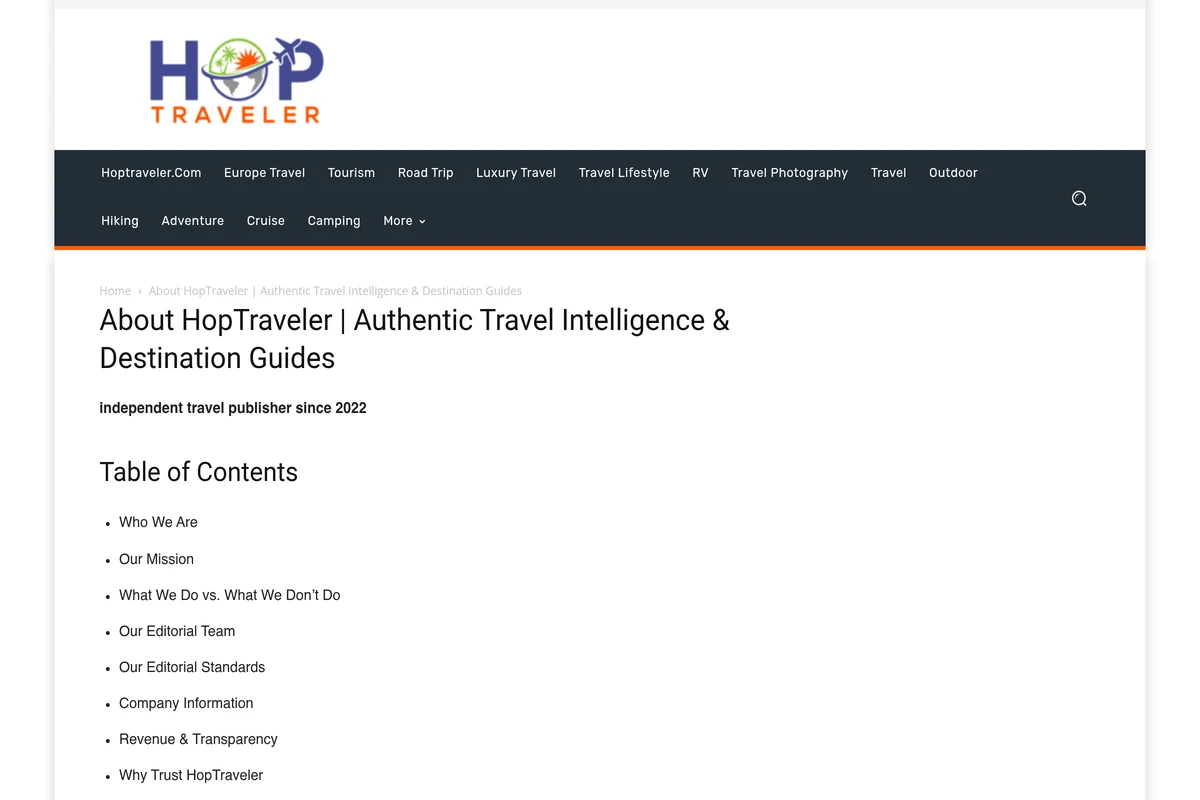
The About page is called “About HopTraveler | Authentic Travel Intelligence & Destination Guides”, and its subtitle reads “Independent travel publisher. Launching smart, honest travel content since 2022”. The page has its own table of contents, which lists Who We Are, Our Mission, What We Do vs. What We Don’t Do, Our Editorial Team, Our Editorial Standards, Company Information, Revenue & Transparency, Why Trust HopTraveler, Contact Us, and Frequently Asked Questions. That list alone tells you the site wants to be judged as a publisher, not as a shop.
The owner is named as HopTraveler Media. No single founder is named anywhere on the About page. Instead, the page names a three person team. Elena Makree is Lead Writer and Strategist, with more than 20 years of experience. John Garavelas is Adventure Specialist, with more than 15 years. Nikolas Hine is Photography Expert, with more than 12 years. The page says the team is made of experienced travelers, writers, and photographers who share firsthand knowledge to help you plan better trips, and it says the website is the company’s primary and only digital property.
The About page is clear about what the site is not. It says, in plain words, that HopTraveler is not a travel agency, tour operator, or booking platform. That is an important line, because the name and the size of the site can make it look like a booking company. It is not. It publishes guides and news, and any booking happens on another website.
The page also describes a five step editorial process: Research, Fact-Check, Experience, Edit, and Update. It says the team uses real firsthand research and checks prices, schedules, and opening hours. We could not verify that process from outside the site, because the process happens behind the scenes, but the claim is on the page and it is part of how the site presents itself. The mission table on the same page lists five kinds of content: Destination Guides for iconic cities, hidden villages, and off the beaten path locations; Travel Strategy for planning tips, budgeting, packing, and transportation; Cultural Insights for local customs, cuisine, and traditions beyond the tourist trail; Adventure Travel for hiking, remote destinations, and outdoor experiences; and Travel Photography for tips, gear, and capturing authentic moments.
Two addresses are shown on the About page. The head office is listed as 444 Alaska Avenue, Suite 1531, Torrance, CA 90503, USA. A European office is listed as Rastenfeld 151, Suite 1531, Rastenfeld 3532, Austria. Two email addresses are shown clearly: smooth954@yahoo.com for general contact and partnerships, and ideas@hoptraveler.com for freelance pitches. No phone number is shown on the About page.
There is one inconsistency on the About page that a careful reader should know about. The header says the site has been publishing since 2022, and a company information section gives “Site Launched: 2022”. But the FAQ section on the same page says the site has been publishing since 2024. Both dates cannot be right. The older date also matches outside checks, which found the oldest posts from October 2022. We report the difference here because a guide site should be judged on accuracy, and this is a case where the site disagrees with itself.
What the Site Covers
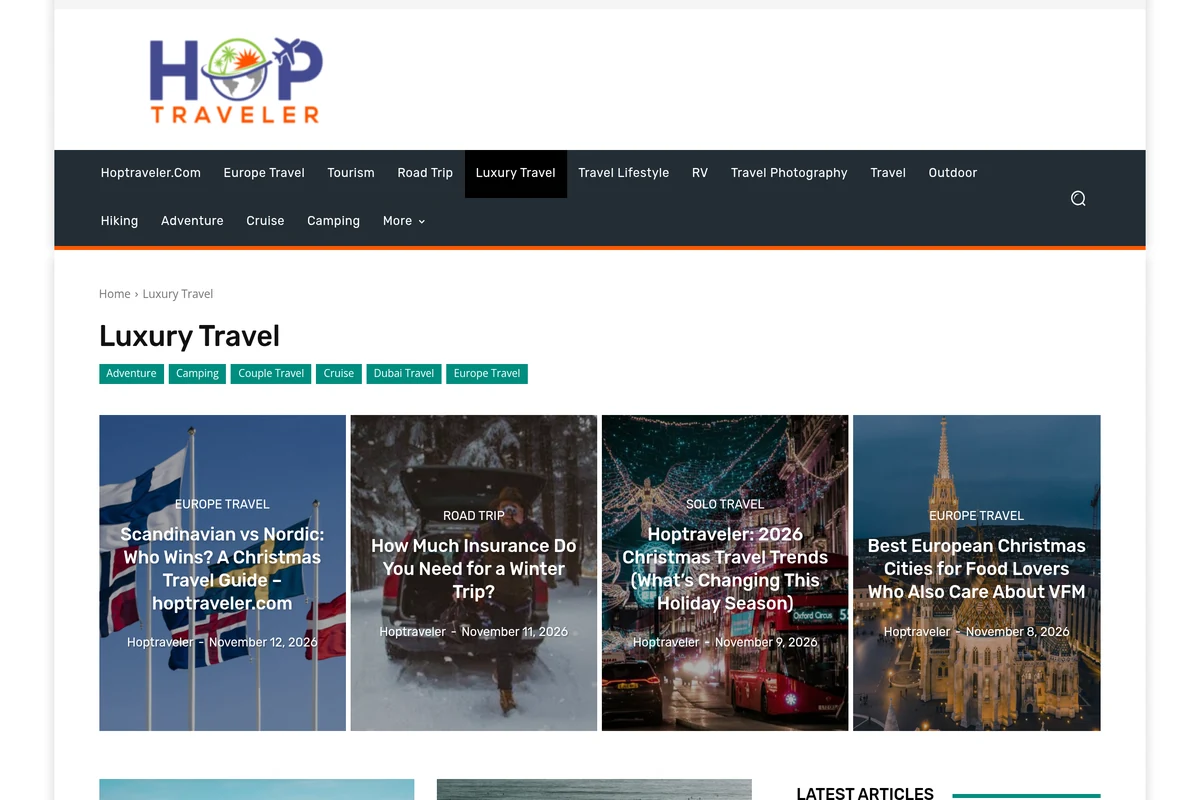
The header menu shows the full range of the site in two rows. The first row lists Hoptraveler.Com, Europe Travel, Tourism, Road Trip, Luxury Travel, Travel Lifestyle, RV, Travel Photography, Travel, and Outdoor. The second row lists Hiking, Adventure, Cruise, and Camping, plus a “More” dropdown and a search button. That menu is the simplest map of the site. If you want Europe, you go to Europe Travel. If you want a driving holiday, you go to Road Trip. If you want a premium trip, you go to Luxury Travel.
The sidebar on the homepage shows article counts for some categories, and those counts show where the site has the most content. Outdoor leads with 1,874 articles, followed by Cruise with 1,566, Tourism with 1,518, Travel with 1,203, Travel Lifestyle with 1,022, and Adventure with 976. Other categories are listed in the sidebar without a count. The numbers change as new articles are published, so treat them as a snapshot from the day we checked, not as a fixed total.
Luxury Travel is one of the largest single sections. Its archive page is titled “Luxury Travel Archives - hoptraveler”, and on the day we checked it showed “Page 1 of 120” with 12 posts per page. That means the section holds well over a thousand articles. Its newest articles on that day were “Why 2026 Is the Year to Visit Sardinia” from November 12, 2026, “Why Travel Insurance Is the Smartest Luxury You’ll Buy This Season” from November 11, 2026, and “Hotel Review: Hotel del Coronado in San Diego, A Classic Beachfront Stay” from November 10, 2026. The category page also shows tag chips for Adventure, Camping, Couple Travel, Cruise, Dubai Travel, and Europe Travel, which shows that luxury on this site is not only about hotels. It includes trips, cruises, and couples travel too.
Europe Travel is smaller but still large. Its archive page showed “Page 1 of 58” with 12 posts per page. Its newest articles on the day we checked were the Scandinavian vs Nordic Christmas guide from November 12, 2026, the 2026 Christmas travel trends article from November 9, 2026, and the best European Christmas cities for food lovers from November 8, 2026. Europe is clearly a core strength of the site, and the newest work leans heavily toward Christmas and winter travel in November.
Families get practical help too. A family travel guide helps you choose one base town, plan short ferry rides, and keep each day to one main activity, which is the same approach HopTraveler uses in its family friendly destination guides. The site does not have a separate family category in the main menu, but family travel appears inside the destination guides, and the guides that work best for families are the ones that pick one base, one main activity per day, and short transfers between stops.
The range of topics is wide, and that is both a strength and a weakness. A reader can find a guide on almost any kind of trip, from RV travel to hiking to cruises to camping. But a reader who wants deep coverage of one small topic may find that the site covers it in one article rather than in a full series. The best way to use the site is to treat each category as a starting point and to read the newest articles first, because travel prices, schedules, and rules change fast.
Recent Articles Worth Reading
The newest articles on the homepage show what the site is writing about right now, and in November 2026 the focus is Christmas and winter travel. Here are the 12 most recent articles from the homepage list on the day we checked, with their dates as shown on the site.
-
“Scandinavian vs Nordic: Who Wins? A Christmas Travel Guide” from November 12, 2026
-
“How Much Insurance Do You Need for a Winter Trip?” from November 11, 2026
-
“Hoptraveler: 2026 Christmas Travel Trends (What’s Changing This Holiday Season)” from November 9, 2026
-
“Best European Christmas Cities for Food Lovers Who Also Care About VFM” from November 8, 2026
-
“Oxford Street’s Car-Free Christmas: Why London’s Most Famous Shopping Strip Just Became a Destination” from October 26, 2026
-
“A Foodie’s City Break in Sarajevo: Europe’s Cheapest Capital” from October 17, 2026
-
“Mykonos in September Is the Season the Locals Prefer” from October 13, 2026
-
“Venice for 3 Days on a Budget: Eat Well, See Everything, Spend Less” from September 21, 2026
-
“4 Days in Stockholm: The Ultimate Guide to Food, Culture & Island Life” from September 16, 2026
-
“Why We All Love Dublin” from September 12, 2026
-
“Is the Mona Lisa smiling?” from September 9, 2026
-
“The Best Season for Traveling Is Now: Why Porto and Lisbon Await in 2026” from September 1, 2026
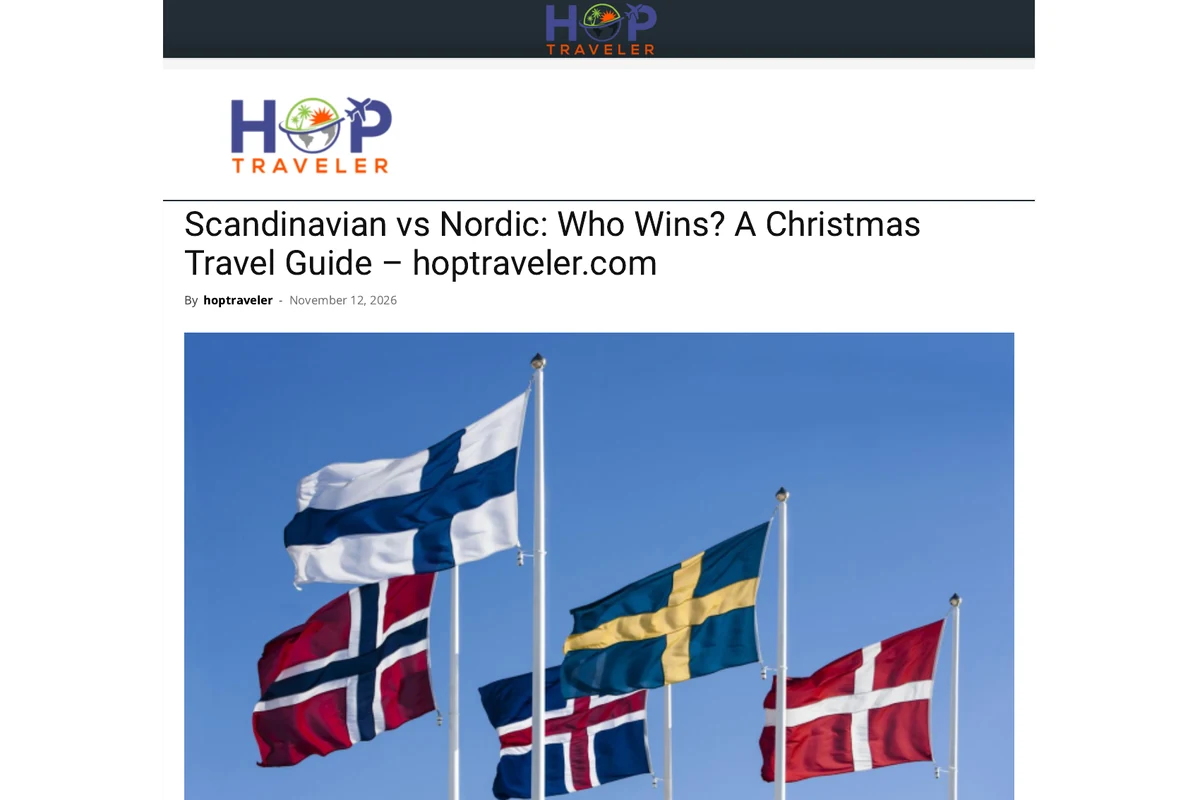
The newest article is the best example of how the site writes. “Scandinavian vs Nordic: Who Wins? A Christmas Travel Guide” was published on November 12, 2026, and it had 4,187 views and 0 comments on the day we checked. It sits in the Europe Travel and Travel Lifestyle categories. It explains that Scandinavian means only Denmark, Norway, and Sweden, while Nordic is broader and adds Finland and Iceland, plus the self governing regions of Greenland, the Faroe Islands, and Aland. So all Scandinavians are Nordics, but not all Nordics are Scandinavian. The article then compares Christmas weather, darkness and polar night, the northern lights, food, and sauna culture, and it offers two itineraries: a classic Copenhagen to Stockholm to Oslo route, and a deeper Finland and Iceland trip. Its conclusion is that the best trip combines both.
The Scandinavian vs Nordic article is a good example of how the site works. It explains that Scandinavian means Denmark, Norway and Sweden, while Nordic adds Finland and Iceland plus Greenland, the Faroe Islands and Aland. If you want the official side of the story, Visit Norway is the official travel guide to Norway, with Christmas ideas, northern lights and fjord information. That official guide is the right next step after reading the HopTraveler article, because it gives current prices, opening times, and booking links that a guide article does not carry.
The second newest article is also useful. “How Much Insurance Do You Need for a Winter Trip?” was published on November 11, 2026, and it had 3,155 views and 0 comments. It sits in the Road Trip category, and its tags are Insurance, Travel Insurance, Winter, Winter Adventures, and Winter Trip. It argues that winter travel insurance is usually worth buying, because it covers flight delays and cancellations, winter sickness and medical costs abroad, and lost or delayed luggage and ski equipment. It also warns about policy traps, including blizzard exclusions, tight definitions of trip interruption, extra fees for skiing and snowmobiling, and cancel for any reason riders. That is practical advice, and it is the kind of article that saves a reader money if they read it before they buy a policy.
Two things about these articles are worth noting. First, every article on the homepage list is credited only to “Hoptraveler”. Individual author names appear only in author bios and article sign offs, and they do not always match. The Scandinavian vs Nordic article is credited to “hoptraveler” in the byline, its author bio is for Elena Makree, and the article text ends with “BY KATE LEE”. A reader cannot tell from the page alone who actually wrote it. Second, the view counts are shown openly, 4,187 views for the newest article and 3,155 for the next, and both showed 0 comments. That suggests the site gets readers but very little on page discussion, so a reader should not expect answers to questions in the comments.
How to Use the Site for Trip Planning
Start with the category that matches your trip. If you are planning a Europe trip, open Europe Travel. If you are planning a drive, open Road Trip. If you want a premium hotel or a cruise, open Luxury Travel or Cruise. The category pages list 12 articles per page, newest first, and the pagination shows how deep the archive goes. Luxury Travel had 120 pages and Europe Travel had 58 pages on the day we checked, so you can go back months or years inside one category.
Use the search box when you already know your destination. A search for a city or a topic is faster than paging through a category, and the site covers so many places that a category browse can take a long time. The search button sits at the right end of the header menu, and it is the quickest way to check whether the site has anything on a specific place.
Read the newest article on your topic first, then check the date on any older article before you trust its prices or schedules. The site publishes often, and a guide from two years ago can still rank in a category while its hotel prices and opening hours have changed. The About page says the team checks prices, schedules, and opening hours, and the editorial process includes an Update step, but the safest habit is to treat every article as a starting point and to confirm the details that cost money on the official site of the place you are visiting.
Before you book anything you read about, check the official Travel Advisories for your destination. A guide can be months old, and entry rules and safety conditions can change after it was written. The advisories page lists the risk levels for each country, including crime, terrorism, unrest, health, natural disaster, and other risks, and it is the page to read before you pay for flights or hotels.
Road Trip is one of the strongest sections for drivers. If you like slow, scenic routes, a scenic drive through old-growth redwoods shows how a single road can carry a whole trip, and HopTraveler’s Road Trip section works the same way, with one route or one idea per article. Use the Road Trip category the same way: pick one route, read the newest article on it, and then check current road conditions and fuel stops before you drive.
The “TRENDING NOW” bar is a useful shortcut when you do not have a destination in mind. It shows the article the site is pushing hardest that day, and on the day we checked it was the best European Christmas cities guide. The four article featured grid below it shows the newest work across categories, so a single look at the homepage tells you what the site is focused on this week.
What the Site Does Not Do
Hoptraveler.com does not book anything. There is no shop, no cart, no price list, no booking widget, and no payment feature on any page we viewed, including the homepage, the About page, two category pages, two article pages, and the Contact page. If you want to book a hotel, a flight, or a tour, you must leave the site and book on another website. That is a limitation to understand before you plan around the site, because you cannot finish a trip on HopTraveler alone.
The site does make money from links. The About page says revenue comes from Display Advertising, Affiliate Links, Sponsored Content, and Collaborations, and it adds a disclosure that some links on the site are affiliate links, and that if you book through them the site may earn a commission at no extra cost to you. No specific booking provider was named on the pages we viewed, and no booking widget or price was seen in the two articles we read. That means a reader cannot tell from an article alone which links earn the site money, so it is good practice to check the final booking page before you pay, and to confirm it belongs to a company you know.
The Contact page is thin. It is titled “Contact Us - Hoptraveler”, and it has no contact form at all. There are no form fields and no submit button. The page only gives the email address smooth954@yahoo.com and a short message that says the team values reader insights, questions, feedback on a story, press inquiries, and topic suggestions. No phone number and no named contact person are shown. A reader who wants to reach the site must send an email, and there is no way to know how fast the team answers.
The site also has no account system. Readers do not create an account, do not save trips, and do not get a personal dashboard. That keeps the site simple, but it means you cannot save a guide or build an itinerary on the site itself. You will need your own notes, bookmarks, or a separate planning tool for that.
Finally, the site does not always agree with itself. We already noted the launch date problem, where the About page says 2022 in one place and 2024 in its FAQ. The authorship problem is similar: the newest article is credited to “hoptraveler” in the byline, its bio is for Elena Makree, and its text ends with “BY KATE LEE”. Neither problem makes the travel advice wrong, but both are reasons to check important facts on an official source before you spend money on them.
Practical Tips for Readers
Check your passport before you plan around a guide. The official passport page explains how to apply, renew and check processing times, and it is the page to use when a guide does not mention documents at all. A guide can tell you where to go and what to see, but it cannot tell you whether your passport is valid for your dates, and that check belongs to the official source, not to a blog.
Trip costs are the other check a guide cannot do for you. Prices in an article can be months old, so build your own total for flights, hotels, tickets and food before you book. A city that looks cheap in a guide can turn expensive once you add theme park tickets, resort fees, parking, and meals, and a city that looks expensive can turn out cheaper when you stay outside the busiest area and use public transport.
Compare the newest article with one older article in the same category. If the advice is the same, it is probably stable. If the newest article changes the advice, trust the newest one. This is a simple test, and it works well on a site this large, because the archive is deep enough that most topics have more than one article.
Save the articles you need as bookmarks, because the site has no save feature. The homepage only shows the newest 12 articles, and an article you read today will slide off the front page within days. If you find a guide you want to use for a trip, bookmark it or save the link in your notes at once.
Be careful with the “More” menu. The header menu has a “More” dropdown, and its contents were not expanded during our check, so we cannot list what sits inside it. If you cannot find a topic in the main menu, open the “More” dropdown or use the search box instead of assuming the site does not cover it.
Finally, read the About page before you trust a site with your trip. It is one of the most complete About pages we have seen on a travel blog, with a team list, an editorial process, company information, revenue disclosure, and a FAQ. The two inconsistencies we found, the launch date and the article authorship, are worth knowing, but they do not change the main fact: the site tells you plainly who it is, how it earns money, and what it does not do.
Frequently Asked Questions
What is Hoptraveler.com?
Hoptraveler.com is a travel news and guide website that publishes destination guides, travel tips, and travel news. It covers 14 categories, including Europe Travel, Luxury Travel, Road Trip, Cruise, Outdoor, Hiking, Adventure, and Camping, and its About page says it has published more than 15,000 guides. It is free to read and does not ask readers to create an account.
Is Hoptraveler.com a travel agency or booking site?
No. The About page says plainly that HopTraveler is not a travel agency, tour operator, or booking platform. It publishes guides and news, and any booking happens on another website. No shop, cart, price list, booking widget, or payment feature was seen on any page we viewed.
Who runs Hoptraveler.com?
The owner is named as HopTraveler Media. No single founder is named on the About page. The team named there is Elena Makree, Lead Writer and Strategist with more than 20 years of experience; John Garavelas, Adventure Specialist with more than 15 years; and Nikolas Hine, Photography Expert with more than 12 years. The site lists a head office in Torrance, California, and a European office in Rastenfeld, Austria.
How many categories and articles does the site have?
The site covers 14 categories. Its About page says it has published more than 15,000 guides. On the day we checked, the homepage showed “Page 1 of 2,649”, the Luxury Travel archive showed “Page 1 of 120”, and the Europe Travel archive showed “Page 1 of 58”, each with 12 posts per page. An independent check in October 2026 counted about 15,900 posts in total.
Can I contact Hoptraveler.com?
Yes, by email only. The Contact page has no form, no phone number, and no named contact person. It gives the email address smooth954@yahoo.com for general contact, feedback, press inquiries, and topic suggestions. A second email, ideas@hoptraveler.com, is shown on the About page for freelance pitches.
Is the information on Hoptraveler.com free to read?
Yes. The site does not ask readers to create an account, and no paywall was seen on the pages we checked. The site earns money from display advertising, affiliate links, sponsored content, and collaborations, according to its About page, and it discloses that some links are affiliate links.
Conclusion
Hoptraveler.com is a large, free travel news and guide blog that is best used as a starting point for trip ideas. Its strengths are its size, its 14 categories, its frequent publishing, and an About page that explains who runs it, how it works, and how it earns money. Its newest work is strong on Christmas and winter travel, and its category archives go deep enough to cover almost any kind of trip.
Its limits are just as clear. It does not book anything, it has no contact form and no phone number, it has no account or save feature, and it disagrees with itself on its launch date and on who wrote its newest article. None of those limits makes the site useless. They mean a reader should use it the way the site itself suggests: read the guide, check the official source for prices, dates, and documents, and then book on a website you trust. Used that way, Hoptraveler.com is a useful first stop before a trip, and a good place to find the next idea when you do not yet know where to go.


Thelowdownunder Travel: What It Is, What It Covers, and How to Use It
Learn what Thelowdownunder.com covers, how its Travel Bug section works, and how to use its travel guides and practical advice wisely.

Intentmedia.com: What It Is, What It Covers, and How to Use It
Learn what Intentmedia.com covers, how its travel guides are organised, and how to use its destination and planning advice wisely.
Travel Tweaks Hotels: How TravelTweaks.com Helps You Find Better Deals, Upgrades, and Smarter Hotel Stays
Travel Tweaks Hotels on traveltweaks.com: what the hotel search tool does, how to compare rates and get upgrades, the 10 hotel hacks grouped as the site shows them, and what the site does not do.